Hotlinks are where other websites link directly to your image so that it shows up on their website. It’s bandwidth theft as they use a part of your webspace to show the image on their website and could also have copyright issues. I’ve written about using images on blogs before so I am not going to go into that again, but you can read it here if you like.
Hotlinks can be malicious. I found one that said “Here They Are My Frightful Kids.” about an image with my three kids in halloween masks. It seems to have come from China so I am not keen to upset them and have just deleted the picture from my blog altogether.
Another hotlinked image was one I bought, and was linked to a s_e_x site, but showed up as a catering site. It refreshed to a s_e_x site when I checked the visit link option, which worried me a fair bit. I’ve deleted that one too.
I could have chosen to change the image to one that said “this image was stolen,” but I’m not keen to deal with those types of websites. I may very well have replaced the image with another one if it was to another blogger who didn’t remove it when I asked them to. If you’re wondering why the _ in the s_e_x word, it’s to stop it being flagged up in Google as a search term 🙂
How to find hotlinks to your website.
Google Image Search is here: http://images.google.com/imghp?hl=en
The magic term to search on is: inurl:scottishmum.com -site:scottishmum.com
Click the magnifying glass to search for images hotlinked to your blog. (Change the site title to yours obviously) Good luck and I hope none of you find any like mine.
You may have to click the image to open it so that you can click “Visit Page” to see where it really goes. ps, you may wish to install McAfee SiteAdvisor in your browser so that it can warn you if it is a risky website that you might end up going to.
A few days ago, I saw a tweet that was retweeted and I followed a link to an article about favouriting tweets.
I opened my surprised eyes as it talked about things that seemed more fitting as terms from fiction riding under the radar of legality.
I chuckled as it talked about hate-faves, fist bumps and too hot to handles. I really can’t repeat any more or I might spit out my coffee.
I honestly didn’t think people used the “favourite” function for anything other than bookmarking tweets. Perhaps I’m niave and perhaps function is the operative word as if I choke on my coffee any more, I might need my bodily functions mopped up.
It made me giggle a fair bit actually. Is this making any sense to you? Honestly, it took me a while to get my grey matter around it.
I found out that wonder of wonders – people are actually favouriting tweets to say thank you, I hate you and much more.
This Twitter Revelation Began Simply:
@QHSEman1 Tweeted this link m.theatlanticwire.com/technology/201…
It seems to me that people could use a favourite to keep note of a Twitter id, to be able to refer to a tweet somewhere down the line and they could even favourite so that they remember to come back later on an anonymous account and rip me to shreds. I guess that’s a hate-fav. I’ve had a few of those. Perhaps a bit of ESP is in my future so I can tell the ones that like me from the ones that don’t. In all reality, I’d really like to know.
The revelation also led me to imagine what secret messages people are trying to convey to Google or Yahoo, or even Jeeves. Favouriting a website on your browser could mean you want to have its babies.
Joking aside, it seems it’s actually a very real issue and lots of different people use them for lots of different things.
If favouriting a tweet was with the intention of a favourite back, or a follow, or to show approval or “like” of a tweet, it might not be interpreted as that by other people.
There are several reasons for not using a favourite as anything other than simply bookmarking a tweet for later:
I did a quick trawl of the Internet and could only come to the following conclusion in answer to the original article which asked “what are you really saying when you favourite a tweet?”
“I’m either bookmarking it, or I’m in spy mode as only I know why I decided to favourite a tweet that you might or might know whether I liked or not and might or might not even ever find out about.”
Confused? I am.

Sweating and with a heavy headache, coming off caffeine was no easy feat. I hadn’t realised I was so addicted until I tried to stop drinking diet fizzy drinks. It wasn’t the aspartame that people tend to attribute as the biggest problem, as that was still in the diluting juices I fizzed with my soda stream instead.
I must have been taking caffeine in large doses although I really had no idea just how much it took to end up with withdrawal. I was obviously sipping enough of it as the withdrawal was very obvious.
I’ve heard people saying that caffeine isn’t addictive, but if you have ever ingested lots of it over a long time frame and tried to stop, you’ll probably get some of the symptoms I suffered with it. I believe caffeine is a mild painkiller, so perhaps lots of us self medicate by using it. Boots tells us that caffeine helps other pain relievers to work better, and is often in over-the-counter pain relievers, cold medications and diet pills.
I know that coffee and tea are the ones we know most about, but where I took most caffeine in was with my Diet Irn Bru and Diet Coke. My kids were also all imbibing it in larger quantities by wanting Pepsi Max which seems to be Diet Pepsi with added extra caffeine. Cocoa beans contain some caffeine, and Pro-Plus tablets / Energy Drinks contain quite high levels.
We all know people who take caffeine to keep them awake or to appear brighter, but where should we draw the limit? On the Diet Coke bottle beside me, I can’t even find how much caffeine is actually in it so keeping tabs on how much we eat/drink isn’t the easiest of tasks.
There is actually less caffeine in Coca-Cola and Coke Zero than in Diet Coke which surprised me.
In 500ml of fluids, there are approximately:
Caffeine stimulates the central nervous system and although we do end up with a dependence, it isn’t thought that it would affect our physical health.
Symptoms of withdrawal usually go away after a few days, and may include:
Daily limits for health are not easily found.
I’ve seen it spoken about that levels around 500mg + of caffeine a day may cause some problems. Although caffeine is a well studied substance, each persons tolerances are different.
I used to drink about 4 litres of diet irn bru a day which would take me to around 200mg of caffeine a day. That’s not a massive amount in the terms of caffeine intake, yet I did suffer incredible headaches and used to get stressed if I thought I was about to run out of my liquid nectar which seems totally daft to me now. I didn’t suffer the other symptoms of withdrawal, but the headache was enough for me. There are times when I drink a Diet Coke that I can have indigestion, so I do think that caffeine has an effect on me.
Is caffeine safe?
Who knows, but the effects certainly seem to have been well studied. I think this is one additive to products we really all have to take our own responsibility for.

When it comes to late Autumn and the cold weather starts to bite, lots of us start to move to comfort food to keep our kids warm on cold days and put some good solid food into their bellies.
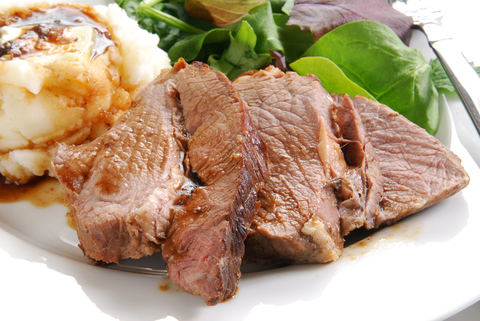
Making roast beef and then later adding all the trimmings is something that we can all do easily and make as healthy or as unhealthy as we want it to be.
Even adding something as simple as a Yorkshire Pudding can make it a dish that everyone would love to sit down to.
Getting roast beef cooked properly is actually easier than most people think it is.
Once it’s cooked, it can be used for a full meal, with salad, mashed, roast or boiled potatoes, or even sliced and added to sandwiches for a fabulous packed lunch.
Choose a Good Cut of Beef
I’d personally choose a rib of beef or a fillet to roast, but there are other options.
Cooking Times
I’d recommend going by the times of your cooker as they can change, or be different from cooker to cooker. As a general rule of thumb, a very hot oven around 220C to start off with for the first 30 minutes in a pre-heated oven.
Lower the temperature of the oven for the rest of the cooking time to about 190 – 200C.
I check my meat by using a thermometer and put it right into the thickest part of the meat.
Options are approximately:
These cooking times and heats are a guide for example only. Guide temperatures can change depending on who is cooking and the roast you have picked. Make sure you follow manufacturers and suppliers instructions to make sure your meat is safely stored, cooked and eaten.
How to Cook Roast Beef
Defying my ability to understand human nature, I am in the court of the poor barman who has probably been hauled over the coals for taking a stand and refusing to serve an obviously pregnant woman with a glass of wine.
It also defies my belief that a heavily pregnant woman would want to go drinking when pregnant and have a glass of wine in the first place. Yes it’s her choice, but for goodness sake, what about the baby in her belly. Do women really not realise that alcohol passes through to the foetus unfiltered?
I know that one glass of wine gets me tipsy nowadays so I really do have to wonder just how tipsy it would make a bubba growing slowly in a belly.
I live with a child suffering the effects of someone else’s drinking as a pregnant woman and I feel nothing but disgust for anyone who isn’t an alcoholic choosing to drink while they are pregnant. I can understand alcoholics as they’re driven by cravings and need, with an illness that is as hard to break as any drug or food obsession, but I can’t understand why someone would want to drink alcohol when they can choose not to.
So, the short version is that someone past their due date popped into a bar for a glass of wine and got refused. And the barman was slated for it.
If someone really had done extensive research on the effects of drinking alcohol while pregnant, I’d find it hard to believe that they’d then choose to have one, but each to their own. They do have to realise though, that other people have their own code of moral conduct and there are other people who just cannot stomach seeing that happen.
The Telegraph quoted
“The barman came up to me and said he wouldn’t serve me because he couldn’t have serving a pregnant woman alcohol on his conscience.”
The woman states:
“I felt like asking whether he refuses to serve fat people pies, or whether the bar checks how much caffeine a woman has consumed that day before they serve her a cup of coffee.”
Well, the fat person eating pies, or the woman drinking caffeine who isn’t pregnant – aren’t taking risks with anyone else’s life but their own.
The Telegraph also stated:
“The NHS advises that pregnant women should drink no more than 1 to 2 units of alcohol, the equivalent of a small glass of wine, once or twice a week to minimise the risk to their unborn child.”
Ding, ding, ding. Disappointing for the Telegraph.
The NHS actually states.
The UK Chief Medical Officers’ advice to women is:
‘Women who are pregnant or trying to conceive should avoid alcohol altogether. However, if they do choose to drink, to minimise the risk to the baby, we recommend they should not drink more than 1-2 units once or twice a week and should not get drunk.’
It also states:
“If women want to avoid all possible alcohol-related risks, they should not drink alcohol during pregnancy because the evidence on this is limited.”
The NHS goes even further to say:
How does alcohol affect my unborn baby?
If you drink alcohol when you’re pregnant, the alcohol crosses the placenta into the bloodstream of the unborn baby and could interfere with how it grows and develops. In the absence of its own blood filtering system, the foetus is unprotected from any alcohol molecules that cross from the mother’s blood.
Alcohol can cause damage to an unborn baby at all stages of pregnancy. Drinking during pregnancy has been associated with:
miscarriage (over 9,000 women are admitted to hospital every year for miscarriages caused by alcohol [NHS Information Centre Hospital Admission data])
low birth weight
heart defects
learning and behavioural disorders
Yes, it’s a womans right to make her own choices, after all, it’s not illegal.
It’s a pity the baby doesn’t have any rights whatsoever until it’s born.
Would the same women who want to glug a glass of wine in pregnancy fill a feeding bottle with wine and have their babies chug down a glass of wine?
You won’t find any foster or adoptive parent who cares for a child affected by the mothers drinking in the womb approving ANY alcohol whatsoever.
Three cheers for that barman. He is my hero of the year.
Looking at the ingredients labels on bottles tins and cans when my kids were little would have me literally scream inside and look around carefully for the bad mother halo replacement to be plonked on my head if I chose to feed them something with horrific artificial content.
I’d plonk the offending food items back on the shelves and carry on sanctimoniously with my shopping.
Food additives seemed almost impossible to avoid unless we made everything from scratch.
All of my boys suffer from ADHD along with the other things they live with daily. I’d spent a lot of time and effort researching what is good and what isn’t for them, and still I got it wrong.
Giving the boys a Fruit Shoot would have them bouncing off the walls and heading for the roof.
At one time, Haribos being fed to my boys would see me looking for the nearest bolt hole to sit out the impending devastation that someone else’s mother has wreaked on my home in the aftermath of their feeding my kids things I’d asked them not to.
I really didn’t give a monkeys about sugar. A sugar rush was NOTHING in comparison to some of the effects of other foods their bodies seemed to send them begging on their hands and knees for.
Additives have to be assessed for safety before they can be used in our food and drink, but that doesn’t necessarily mean that they’re all ok for every person. Due to EU laws, all food must be labelled clearly in the ingredients section, but here too, I found it difficult to tell the difference when there are several terms that can be used for the same thing.
I quickly learned that there were ingredients to avoid, and others that didn’t matter too much.
The Food Standards Agency has also said that consumption of mixes of some artificial colourings with the preservative called sodium benzoate could also lead to an increase in hyperactivity in some children.
The artificial colours they identified were:
The FSA states
“A European Union-wide mandatory warning must be put on any food and drink (except drinks with more than 1.2% alcohol) that contains any of the six colours. The label must carry the warning ‘may have an adverse effect on activity and attention in children’.”
As a family, we’ve noticed a big difference with sunset yellow and sodium benzoate. It rules out a lot of orangey / yellow coloured drinks, but the kids are glad now that some of the things they used to be banned from, they can now eat.
I’ve a lot of respect for the companies actually making the effort to provide good substitutes for artificial colorings in food. I wish more would do the same, and consider doing away with monosodium glutimate too as that gives me a headache.
Research was also undertaken by Southampton University which suggested eating or drinking some artificial food colourings could be linked to a negative effect on childrens’ behaviour.
The FSA has amended their advice to state:
” If a child shows signs of hyperactivity or Attention Deficit Hyperactivity Disorder (ADHD), eliminating the colours considered in the Southampton study from their diet might have some beneficial effects on their behaviour.”
Nobody knows more about the effects of some additives and foods on our individual children, but if you need to find out more about the research, it’s available on the FSA website.
Chronic and acute effects of artificial colourings and preservatives on children’s behaviour

Two of my boys have hypermobile joints. You know the ones that can turn their elbows inside out, or stick out their shoulder blades at completely stomach churning angles. One of mine can do that.
Littlest can turn his feet to direct opposites of each other.
In simple terms, hypermobility is the ability to move our joints further than the normally expected range of movement. It can range from very mobile to some of us with almost no mobility at all (like me).
Many hypermobile jointed people are described as “double jointed.”
The different levels can made a big difference to quality of life. My boys are lucky enough that theirs is easily spotted, yet allows them to still lead an active and quality life. They can do things like stick their shoulder blades out at wierd angles that make me cringe, to folding their thumbs back so that they they are in line with their arms.
How common is it?
It’s fairly common at some level in our population. For some people, it might just be elbows and fingers and for others it may just be fingers that make it difficult to hold a pencil. Yet more people might find it difficult to do some everyday things, and for others it might even be a benefit. Imagine if you are an athlete whose edge could be that your hip joints give you that little more flexibility for each step and propels you further forward.
I watched a TV programme that Cheryl Cole was on where she demonstrated her hypermobile elbows, so it can affect anyone.
Quite often children seem to “grow out” of HMS as it can often seem to reduce as they get older.
Problems
My youngest has learned that it doesn’t take much to dislocate his thumb. It folds back on itself, right to his arm, but a knock easily dislocates it. That is incredibly painful for him and although it pops back in place easily, it takes a good couple of weeks for the pain to subside. I suspect that occurs as although his joint over extends easily and he doesn’t really realise that it can go too far. I’m grateful his healed up fine, as HMS injuries can be difficult to recover from.
He struggles to hold his pencils or pens correctly and although there are pens and pencils for people with HMS, in reality, it’s difficult for them to keep hold of. Other children tend to want to try them or they are easily broken. Children often don’t want to be different from their peers and might just not use them anyway.
We’ve got round that for lengthy writing exercises by having a laptop available for him to use, but again, he has to be told to use it or he’ll just potter on with struggling to hold his pencil and not manage to write very much. It takes so much effort to just put pen and pencil to paper, that the quality and quantity of output can be quite poor and the condition unrecognised as an issue by teachers.
Pain
Some HMS affected people can experience pain from their joints, and it can be to the extent that it is misdiagnosed or interfere with daily living. Thankfully we have not got to that point and hopefully we never will, but it is always good to know what the future potential can be.
Diagnosis
It does pay to have HMS diagnosed. I hadn’t realised what it was until my eldest had a thumb injury and the physiotherapist told me he had it, and she watched my youngest writing and told me he also suffered from it in his fingers and thumbs.
Without the diagnosis, youngest wouldn’t have his school laptop and we wouldn’t know to watch out for hand injuries.
If they had less obvious symptoms I wouldn’t have bothered. I just thought eldest and his shoulder blades were a bit like a party trick. Diagnosis also helps to pinpoint later on if there are some more serious effects and it helped us to understand that it wasn’t much of a blow that dislocated both eldest and littlests thumbs on different occasions.
There is a scoring system, the “Beighton Score” which grades the body to identify possible hypermobility in some parts of the body, but it is usually best diagnosed by a doctors examination and they can help suggest things to help if it is causing problems in life.
Where do I get help?
Find out more about HMS by visiting the following:
One of the things that I’ve always enjoyed on holidays is the ability to chill out on a lazy afternoon and just enjoy spending time with people I really want to be with.
In April this year, the BBC reported that there are “more than 160m cups drunk every day – and a resurgence in the popularity of afternoon tea.”
I don’t think tea is limited to just the afternoon, but it really does give the impression of sitting down with best bib and tucker over a plate of tea, scones, dainty cakes and cucumber sandwiches.
When my kids were wee, I used to love taking them out and we often used to just stop off for afternoon tea.
That’s something we’ve grown out of a little since they’ve got bigger, and it’s only now when I’ve written about it that I remember how much I actually miss that interaction and discussion time with my children. It’s just not the same going into a kids cafe or local greasy spoon for a cuppa.
I used to work in an oil services company so I’ve had afternoon tea in many hotels with lots of plates of gorgeous cakes and sandwiches to choose from. It was more often called lunch than afternoon tea, but it was 100% afternoon tea.
When I visit my dads girlfriend in St Andrews, she always takes me to a hotel for tea and it seems to be a staple in her crowd and a popular thing to do.
I know that our local Dobbies does a roaring trade in a more watered down version where we don’t get served but have to make our own choices. I can’t help thinking that being served is the whole point of enjoying the full experience.
Someone asked me how I pronounced scone. It sounds simple at first glance, but apparently it divides nations. I pronounce mine sc-on where some people prefer sc-own. Perhaps there are other versions too, a bit like potatoes, potatos.
There’s even a whole etiquette around afternoon tea in a posh place, so take note. I found the piece by William Hanson on the Gino and Mel entertaining but I obviously know very little about how to have afternoon tea in the old fashioned way. It’s a really good watch.
The Telegraph outlines the history of how sitting for afternoon tea came about and it’s fascinating to read that it was a Duchess in the early 1800’s who felt hungry between meals and began to make a social occasion of a snack between main meals. It was a secret activity at first, it quickly became the norm and is still practised in all shapes and forms today as a formal ceremony between meals and to gather friends together.
Nowadays, afternoon tea can be as simple as sitting at home with a friend or two and a mug of hot tea with home bakes, to the formal tea sittings in large hotels. The beauty of it is that afternoon tea can take whatever form we want it to, but it is nice to be served by staff in a crisp and smart uniform.
Afternoon tea for me recently has mainly been sitting at a kitchen table with a friend or two, putting the world to rights while our kids are at school.
I think the biggest question for most with English tea has to be how to add the milk and sugar. I’m a teapot or teabag gal with no sugar, and milk put in the cup last.
My mother is a teabag lady and prefers her milk in the bottom of the cup with the tea poured on top. I understand that with teapot tea, but with teabag tea, the tea masks in the cup and I think the milk in first would interfere with that.
Perhaps afternoon tea should be on my agenda more.
Brought to you in collaboration with Hotel Direct.

Making a sponge cake is the easiest thing there is to bake. Don’t let anyone tell you that it’s difficult, hard, or in any way something that only bakers can do.
The quantities and proportions for a basic cake never change. For the filling on this cake, I don’t bother to weigh as butter icing is just so easy.
If you want an absolutely perfect looking cake, you can use a sharp knife to trim round the edges and make it look perfect before sprinkling icing sugar or adding your filling.


My old machine said hot or cold water. No way cold water cooks the veggies in my old machine. Actually…
[…] liquid. Using boiling water for stock can speed up cooking, according to user tips published by Scottish Mum (Practical…
Quick, creamy, and packed with zing this is my kind of lunch Thanks for the easy, nourishing recipe, Scottish Mum.